In This Article
- What's Changed and When
- The Origin Angle: Where Your Goods Are Made Matters
- What This Means for Your Margins
- VAT and IOSS: What Hasn't Changed
- Shipping Model: DDP Is Becoming Non-Negotiable
- Should You Move to EU-Based Fulfilment?
- The Bigger Picture: It's Not Just the EU
- What to Do Now
- Which Tools Can Do This?
If you ship products to EU customers from outside the EU, the rules just changed. The €150 customs-duty exemption that let low-value parcels into the EU duty-free has been abolished. It's not a proposal. It's law.
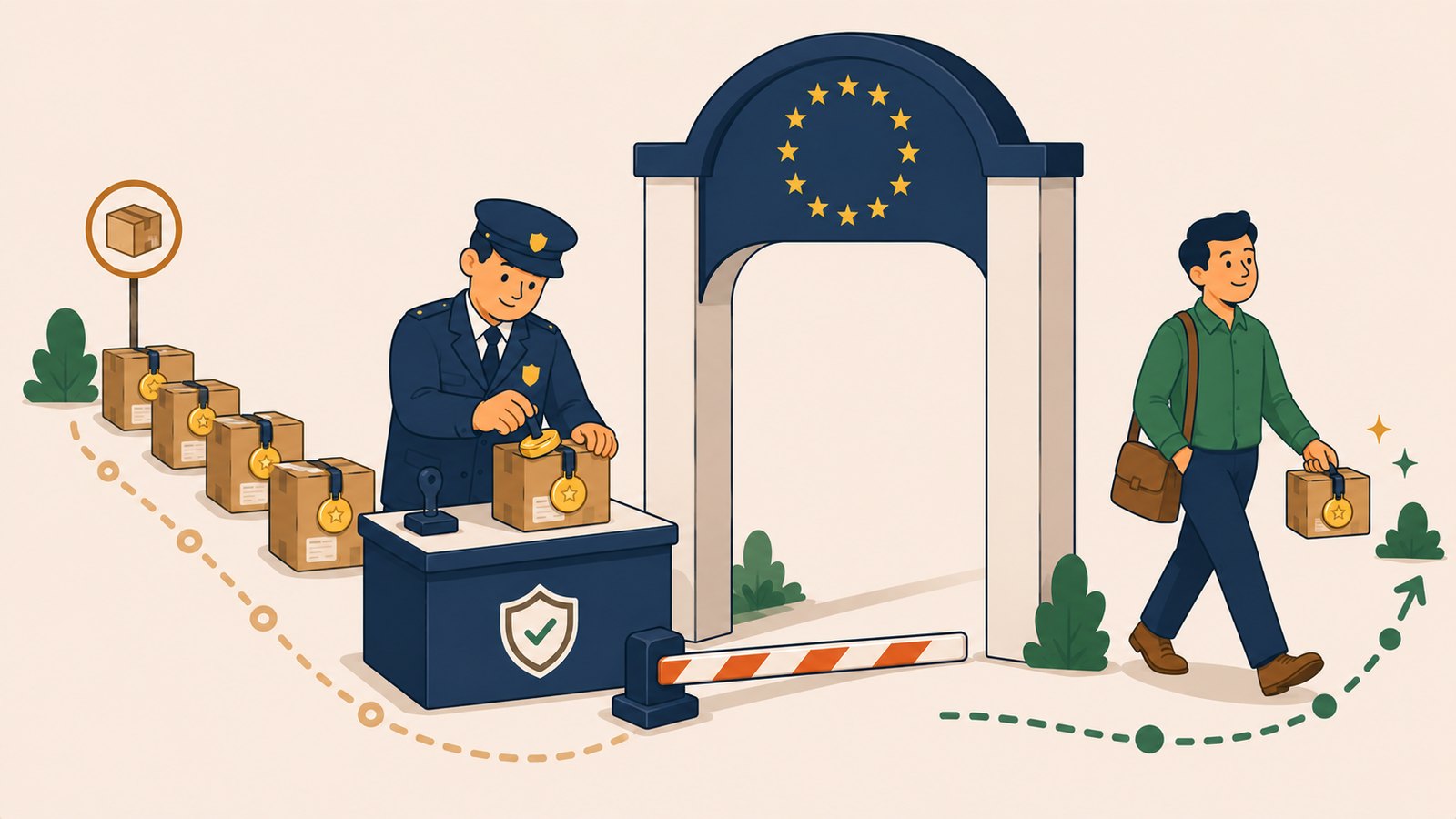
Since 1 July 2026, an interim flat customs duty of €3 applies to any parcel under €150 sent directly to an EU consumer, charged per product category in the parcel. That's on top of the VAT you're already collecting. For some sellers this adds a few euros per order. For others, particularly those on thin margins, it changes whether certain products are worth selling into the EU at all.
Here's what's actually happening, what's confirmed versus what's still being finalised, and what you need to do now.
What's Changed and When
The EU had two separate de minimis thresholds for imports. The VAT one (€22) was scrapped back in July 2021, which is when IOSS came in. The customs-duty one (€150) survived until now.
Council Regulation (EU) 2026/382, adopted on 11 February 2026, formally abolishes the €150 customs-duty relief. The driving force behind it is volume: 4.6 billion low-value parcels entered the EU in 2024, 91% of them from China. Temu, Shein and AliExpress are the obvious names, but the rule change catches everyone shipping B2C into the EU, wherever in the world you're based.
What's law right now: The €150 duty exemption is gone and an interim flat €3 duty applies from 1 July 2026. It's charged per product category (4-digit tariff heading) in each parcel, so a parcel containing items from three different categories pays €9. This is settled.
What's agreed in principle: The wider EU Customs Reform reached provisional agreement between Council and Parliament on 26 March 2026. Under it, the permanent shift to full standard tariffs (not the flat €3, but actual percentage-based duties by product category) is expected around 1 July 2028. Still needs formal adoption.
What's proposed but not confirmed: A €2 handling fee per parcel delivered to a consumer (€0.50 for parcels going to a warehouse), expected around November 2026. Parliament wants platforms to pay it, not consumers. The exact start date and who pays are not settled.
The Origin Angle: Where Your Goods Are Made Matters
This is the bit most sellers are missing. The EU's change applies to all non-EU imports, but many countries have trade agreements with the EU that grant zero or reduced tariffs on goods meeting preferential rules of origin. The UK has one (the Trade and Cooperation Agreement). So do Canada, Japan, South Korea, Vietnam, Switzerland, Norway and a long list of others.
If your products are genuinely made in a country that has an EU trade agreement, and they meet that agreement's product-specific rules of origin, you can make a valid origin claim and they still enter the EU at 0% or reduced duty. The de minimis removal doesn't touch this.
But if you're in a country with no EU trade agreement (China and the United States are the big ones), or your goods are simply warehoused in your country rather than made or substantially processed there, they don't qualify. Once the exemption goes, they face duty. A lot of sellers are going to get caught here because they assume "shipped from my country" means "originates in my country." It doesn't.
If you're a UK seller specifically, the rules of origin route is worth understanding in detail. Read our full guide: TCA Rules of Origin: How UK Sellers Can Still Ship to the EU Duty-Free.
What This Means for Your Margins
The impact depends entirely on what you sell and where it's made. A €60 clothing item with no TCA origin claim looks like this:
| Cost | Before 1 Jul 2026 | Interim (1 Jul 2026) | Full reform (~2028) |
|---|---|---|---|
| Customs duty | €0 | €3 flat | ~€7.20 (12% apparel) |
| Import VAT (21%) | €12.60 | €13.23 | €14.11 |
| Handling fee | n/a | ~€2 (if adopted) | ~€2 |
| Extra cost vs before | n/a | ~€6 | ~€11 |
On thin-margin categories, €11 extra per order is enough to wipe out your profit. On the other hand, consumer electronics often carry 0% duty, so the impact there is minimal (just the handling fee if it goes through).
One thing worth noting: during the interim phase, the flat €3 is actually cheaper than the eventual percentage tariff for many mid-value items. That's a temporary window worth planning around.
For a full breakdown across product categories with worked examples, see: How to Calculate Your New EU Landed Cost.
VAT and IOSS: What Hasn't Changed (and What Might)
VAT itself isn't affected by this reform. It's been due from €0 since 2021, and IOSS handles the collection and remittance for consignments up to €150. That's unchanged.
What is on the table for around 2028 is removing the €150 IOSS cap so it can cover higher-value goods, and shifting more import-VAT liability onto marketplaces. If you sell through Amazon, they likely already handle IOSS on your behalf. Check your Seller Central settings to confirm.
Shipping Model: DDP Is Becoming Non-Negotiable
The major carriers (FedEx, DHL, UPS, and national postal operators) are all pushing sellers toward DDP (Delivered Duty Paid), where you collect duty and VAT at checkout. The alternative, DAP (Delivered At Place), means the customer gets a surprise bill at the door, which drives refusals, chargebacks, and terrible reviews.
FedEx has already announced a disbursement fee of €15 or 2.5% of duty/tax (whichever is higher) from 20 July 2026 for DAP shipments. The economics of DAP are getting worse fast.
We've written a detailed comparison: DDP vs DAP: Which Shipping Model for Your EU Customers.
Should You Move to EU-Based Fulfilment?
For sellers with consistent EU volume, bulk-importing into an EU warehouse and clearing customs once often beats per-parcel duty and handling. You also qualify for the lower €0.50 warehouse handling rate instead of €2. The trade-off is EU VAT registration obligations.
Full breakdown here: EU Fulfilment vs Per-Parcel Shipping: When to Make the Switch.
The Bigger Picture: It's Not Just the EU
The EU isn't alone in scrapping low-value import relief. The US ended its $800 de minimis for China and Hong Kong from May 2025, and for all countries from August 2025. The UK government confirmed at Autumn Budget 2025 it will abolish the £135 low-value import relief, with a consultation that closed in March 2026 and removal expected by March 2029 at the latest.
The direction globally is clear: low-value import exemptions are disappearing. Building your operations around them is no longer viable.
What to Do Now
The €3 duty is already in effect, with the handling fee and full tariffs still to come. If you haven't adjusted your EU operations yet, here's the minimum:
Recalculate your landed cost by product category and destination. Model the €3 duty and likely €2 handling fee into every SKU. Decide what you absorb, pass on, or delist.
Get your HS codes right. Classification determines your duty rate. Misclassification risks penalties and clearance holds. Audit your top SKUs now.
Assess your origin status. If your country has an EU trade agreement and your goods genuinely qualify, get your documentation in order. If not, stop assuming they do.
Move to DDP. Work with your carrier to collect everything at checkout. Talk to your customers about pricing changes honestly and early.
Sort your IOSS registration if you haven't already, and confirm whether your marketplace handles it on your behalf.
Which Tools Can Do This?
Landed cost modelling can be done in a spreadsheet, but if you're managing it across hundreds of SKUs and multiple EU destinations, tools like Zonos, Avalara, or your ERP's customs module will save significant time. To check the duty rate for any product category, the EU's own databases are free to use: Access2Markets gives duty, VAT and rules of origin by product and route, and TARIC holds the underlying tariff. For HS code classification, Tariff Number (free) or customs broker databases are useful starting points. Carrier-specific portals (FedEx, DHL, UPS) all have DDP configuration tools.
If you'd rather have someone model the landed cost impact, sort your origin documentation, and set up the right shipping and customs structure, that's what Fulcrum Three does.
We'll model the landed-cost impact across your range, sort your origin documentation, and set up the right shipping and customs structure now the rules have changed.
Book a Free Operations Audit →