In This Article
With the EU's €150 customs-duty exemption gone and per-parcel charges stacking up, a lot of sellers outside the EU are asking the same question: does it make more sense to ship stock in bulk to an EU warehouse and fulfil locally?
The short answer is that it depends on your volume, your margins, and how much EU VAT complexity you're willing to take on. The longer answer involves some maths worth doing properly.
The per-parcel problem
Under the new rules (from 1 July 2026), every B2C parcel shipped directly into the EU to an EU consumer faces:
The €3 flat customs duty, charged per product category in the parcel (interim measure). A likely €2 handling fee per parcel delivered to a consumer (expected November 2026, not yet confirmed). Carrier disbursement or brokerage fees if you're using DAP. Plus whatever customs clearance charges your carrier applies per shipment.
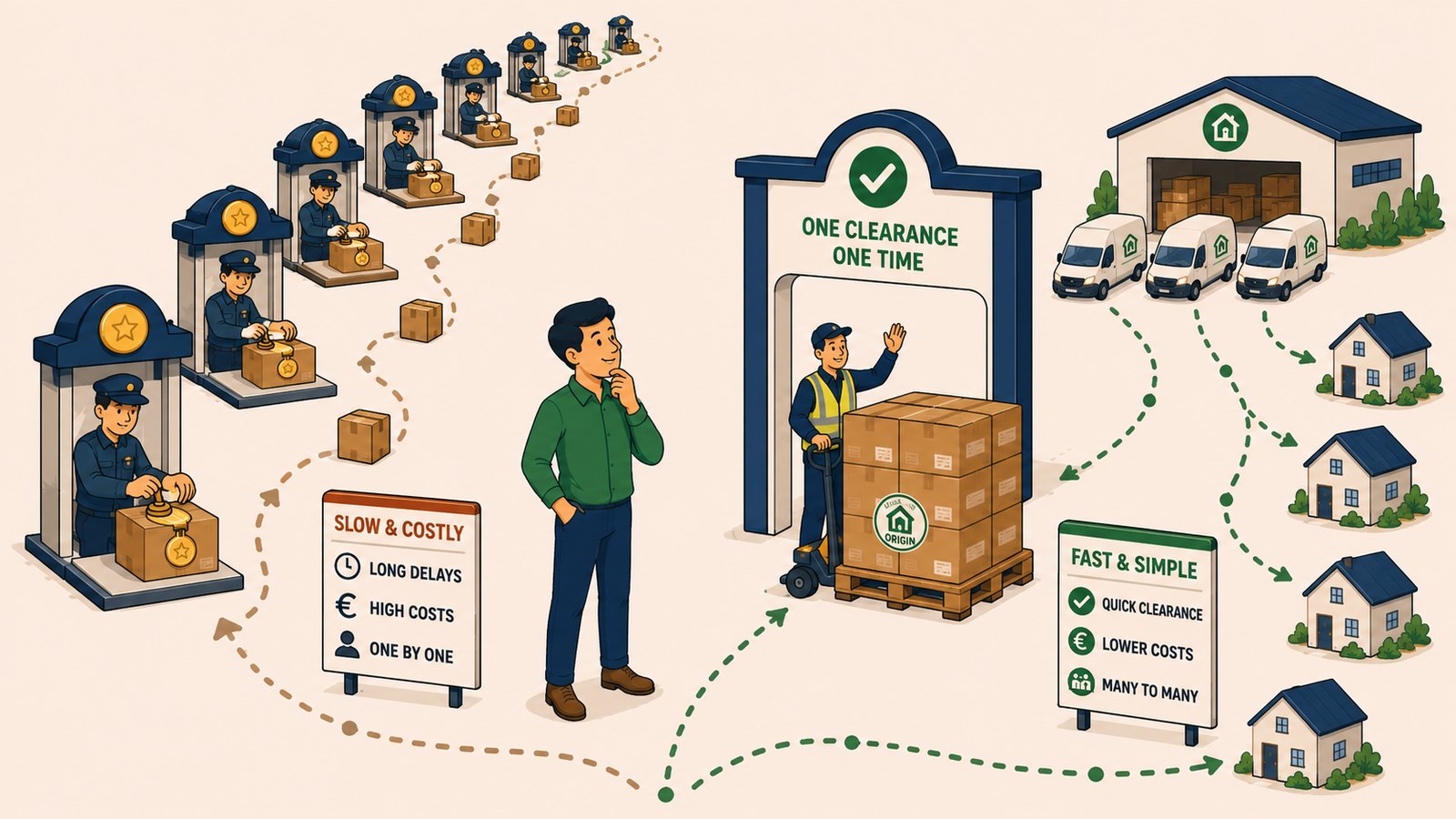
On a single order, these charges might seem manageable. But multiply them across hundreds or thousands of orders per month and the per-parcel model gets expensive fast. Each parcel requires its own customs declaration, its own duty payment, and its own clearance. There's no volume efficiency.
The EU fulfilment alternative
Bulk-importing stock into an EU-based warehouse (your own, a 3PL, or Amazon FBA) means you clear customs once on the whole shipment rather than on every individual parcel. The duty you pay is the standard tariff rate for your products (based on HS classification, which you can look up on the EU's Access2Markets portal or in TARIC), and you pay it on the bulk consignment value.
Once the stock is in the EU, orders ship domestically. No per-parcel customs clearance. No carrier disbursement fees. Faster delivery times for your EU customers. And if the proposed €2 handling fee goes through, parcels going to a warehouse attract a rate of just €0.50 instead of €2.
Running the numbers
Here's a simplified comparison for a seller outside the EU doing 500 EU orders per month, selling a €40 clothing item sourced from China (no TCA origin claim):
Per-parcel model (shipping direct into the EU):
| Cost per order | Interim (Jul 2026) | Full tariff (~2028) |
|---|---|---|
| Customs duty | €3 | €4.80 (12%) |
| Handling fee | €2 | €2 |
| Carrier customs clearance | ~€3-5 | ~€3-5 |
| Extra cost per order | ~€8-10 | ~€10-12 |
| Monthly extra (500 orders) | €4,000-5,000 | €5,000-6,000 |
EU fulfilment model (bulk import to EU warehouse):
| Cost | Interim | Full tariff (~2028) |
|---|---|---|
| Customs duty (on bulk import) | Standard tariff on consignment | Same |
| Handling fee | €0.50 per parcel to warehouse | €0.50 |
| Carrier customs clearance | Once per bulk shipment | Once |
| EU 3PL storage/pick/pack | ~€2-4 per order | ~€2-4 |
| Extra cost per order | ~€3-5 | ~€5-7 |
| Monthly extra (500 orders) | €1,500-2,500 | €2,500-3,500 |
The gap widens with volume. At 500 orders per month, EU fulfilment saves roughly €2,000-3,000 monthly. At 1,000 orders, it's more like €4,000-6,000. The breakeven point where EU fulfilment starts winning is typically somewhere around 100-200 orders per month, though it varies by product category and duty rate.
The trade-off: EU VAT registration
This is what puts sellers off, and it's a real consideration. Storing stock in an EU member state triggers a VAT registration obligation in that country. If you use Amazon FBA in the EU (particularly Pan-EU or EFN), stock gets moved between fulfilment centres across multiple countries, which can create VAT obligations in each one.
The compliance burden includes registering for VAT in each relevant country, filing periodic VAT returns, keeping records that satisfy each jurisdiction, and potentially appointing a fiscal representative in some member states.
This isn't trivial. It costs money (VAT registration and ongoing filings commonly run €500-1,500 per country per year through an agent) and creates ongoing admin. But for sellers doing meaningful EU volume, the duty and handling savings from EU fulfilment usually outweigh the VAT compliance costs significantly.
Amazon sellers: what to check
If you're already using Amazon FBA in Europe, some of this is handled for you, but not all of it.
Check your FBA programme configuration. Are you using Pan-EU (stock distributed across multiple countries), EFN (European Fulfilment Network, stock in one country shipped cross-border), or single-country FBA? Each has different VAT implications.
Amazon acts as deemed supplier for certain sales, meaning they handle VAT collection and remittance. But this doesn't cover your import duty obligations or your VAT registration requirements for countries where you hold stock.
Review your EU import settings in Seller Central. Make sure your EORI number, shipping preferences, and customs settings are correct for the new rules.
When to stay with per-parcel
EU fulfilment isn't always the right move. If your EU volume is low and unpredictable (under 50-100 orders per month), the fixed costs of a 3PL contract and multi-country VAT registration may not justify the per-parcel savings. If you sell products with 0% duty rates (many consumer electronics categories), the per-parcel duty charge is minimal. And if your products are genuinely origin-qualifying under an EU trade agreement (UK goods with valid TCA preference, for example), they enter at 0% duty per-parcel anyway, which removes the biggest cost advantage of EU fulfilment.
For seasonal sellers, a hybrid approach can work: bulk-ship stock to the EU ahead of peak season and use per-parcel for the rest of the year.
Customs reliefs worth knowing about
For higher-value or high-return sellers, a few EU customs reliefs can reduce costs further:
Customs warehousing lets you store goods in an approved warehouse and defer duty payment until the goods leave the warehouse for sale. Useful if you hold slow-moving stock.
Inward processing provides relief on duty for goods that are imported, processed, and then re-exported. Relevant if you're doing any assembly, finishing, or customisation in the EU.
Returned goods relief avoids paying duty twice on products that are returned by EU customers and then re-shipped. Without this, a returned item re-entering the EU faces duty again.
Which Tools Can Do This?
For EU 3PL options, services like byrd, Hive, ShipBob (EU), and Amazon FBA all offer EU-based fulfilment. For VAT compliance, agents like SimplyVAT, AVASK, and Meridian Global Services handle multi-country registration and filing. For modelling the per-parcel vs bulk cost comparison, a spreadsheet with your actual order volumes, duty rates, and carrier charges will give you the most accurate picture.
If you want help modelling the numbers for your specific product range and working out the right fulfilment strategy, Fulcrum Three can run that analysis and build the business case with you.
We'll model the per-parcel versus bulk-import numbers for your range, weigh the VAT trade-offs, and set up the right fulfilment strategy now the rules have changed.
Book a Free Operations Audit →