In This Article
If you're shipping B2C parcels into the EU from outside it, the question of who pays customs duty and VAT at the border isn't just a logistics detail. It's a customer experience decision that affects your return rate, your reviews, and whether that customer ever buys from you again.
With the EU's €150 customs-duty exemption now gone (from 1 July 2026), every parcel faces duty. That makes the choice between DDP and DAP more consequential than it's ever been.
The two models, plainly
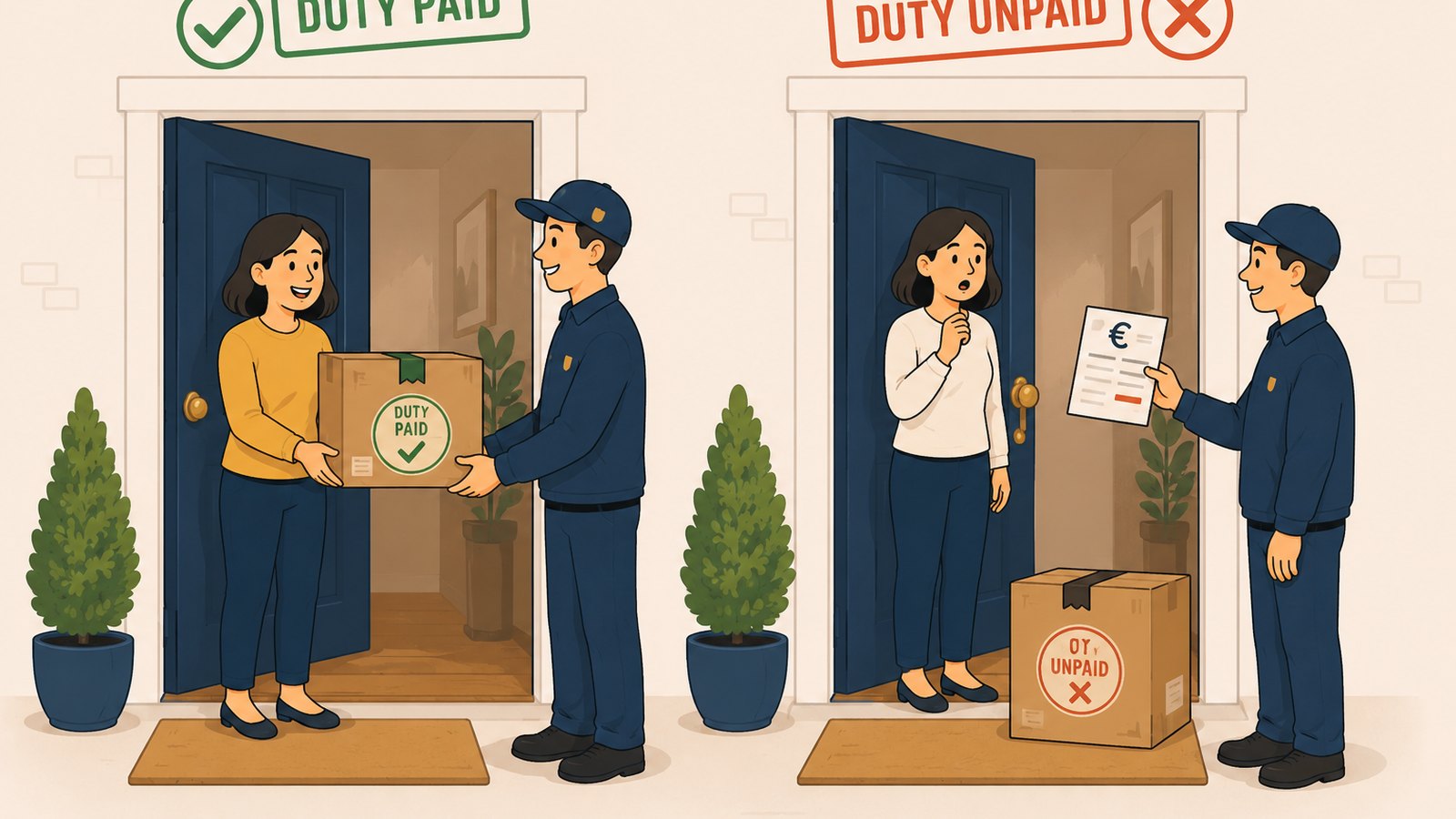
DDP (Delivered Duty Paid) means you, the seller, pay all customs duties, taxes, and fees before the parcel reaches the customer. The customer pays one price at checkout and the parcel arrives with nothing more to pay. You handle the customs clearance, either directly or through your carrier.
DAP (Delivered At Place) means the parcel ships with duties and taxes unpaid. The carrier or postal service collects them from the customer on delivery, or the customer has to go to a collection point and pay before they can pick up their order. On top of the duty and VAT, the carrier usually charges a handling or disbursement fee for fronting the payment.
Why DAP is becoming unworkable for B2C
Before the de minimis removal, DAP on low-value parcels was tolerable because there was often no duty to pay. VAT was usually handled through IOSS at checkout. The customer experience was mostly fine.
That's changed. Now every parcel under €150 carries at least a €3 duty charge, and carriers add their own fees on top for processing it. The customer ordered something for €40, and a week later someone's asking them to pay an extra €8-15 before they can have it. That's the experience you're delivering.
The problems compound fast:
Refused deliveries. Customers who don't expect extra charges refuse the parcel. You've paid for shipping both ways and lost the sale. Return rates on DAP shipments into the EU are significantly higher than DDP.
Chargebacks and complaints. Some customers pay the charges, then dispute the original transaction or leave a negative review. "Hidden fees" is one of the most common complaints in cross-border ecommerce.
Carrier fees make it worse. FedEx has announced a disbursement fee of €15 or 2.5% of duty/tax (whichever is higher) from 20 July 2026 on shipments where the carrier advances duty and tax. DHL and UPS have similar fee structures. On a €40 parcel, the carrier's fee alone can exceed the duty.
Customer trust erodes. Even if the customer does pay and receives the product, the experience leaves a bad impression. They're far less likely to reorder, and far more likely to leave a review mentioning unexpected charges.
What the carriers are saying
The major carriers have all published guidance on the de minimis changes, and the direction is unanimous: move to DDP.
FedEx has dedicated EU customs-reform pages and is actively promoting DDP solutions. They've confirmed the €3 duty per declaration line from 1 July 2026 and flagged the expected €2 handling fee from November 2026. Their new disbursement fee on DAP shipments is a clear signal that DAP is being priced out.
DHL Express published specific guidance confirming the de minimis removal and the 1 July 2026 effective date. Their account teams are steering B2C sellers toward DDP arrangements.
UPS has an "Adapting to EU De Minimis Changes" page and is promoting its own DDP solutions.
National postal operators are running European trade insights hubs with notices on the duty changes.
It's worth noting that DHL, FedEx and UPS jointly wrote to EU finance ministers in late May 2026 warning that the timeline risks disruption at borders. Expect some operational turbulence around go-live, which makes having your shipping model sorted in advance even more important.
How DDP works in practice
Switching to DDP means you need to:
Calculate duty and VAT at checkout. You need to know the applicable duty rate for each product (based on its HS code and origin, which you can check on the EU's Access2Markets portal) and the VAT rate for the destination country. This gets added to the checkout price so the customer sees one all-in figure.
Register for IOSS (if you haven't already) to handle VAT on consignments up to €150. Check whether your marketplace already does this on your behalf. Amazon, for example, handles IOSS for most FBA and marketplace sales.
Work with your carrier on customs clearance. Most carriers offer DDP services where they handle the customs declaration and duty payment on your behalf, then invoice you. Set this up with your account manager.
Get an EU EORI number. You need one to act as importer. If you're not established in the EU, you'll generally need indirect representation by an EU customs agent, who becomes jointly liable for the customs debt.
Update your checkout and pricing. Your product prices need to reflect the landed cost including duty. Be transparent with customers. "Price includes all taxes and duties, no additional charges on delivery" is a selling point, not a footnote.
The cost of getting it right vs getting it wrong
DDP costs you more upfront. You're absorbing (or building in) the duty and handling the admin. But the alternative is a customer experience that actively damages your business.
A rough comparison on a €50 order shipped from outside the EU to Germany:
| DDP | DAP | |
|---|---|---|
| Duty collected | At checkout (built into price) | At door (€3 + carrier fee) |
| Customer pays extra on delivery | Nothing | ~€8-18 |
| Carrier disbursement fee | None | €15 or 2.5% |
| Return/refusal risk | Low | High |
| Customer experience | Clean | Poor |
The maths is straightforward. The short-term cost of DDP is lower than the long-term cost of lost customers, refused deliveries, and reputational damage from DAP.
When DAP still makes sense
There are a few scenarios where DAP isn't unreasonable: high-value B2B orders where the buyer expects to handle their own import clearance, one-off or infrequent EU shipments where setting up full DDP infrastructure isn't worth it, or where the buyer has explicitly agreed to handle import charges (and understands what that means).
For regular B2C ecommerce, DAP is increasingly hard to justify.
Which Tools Can Do This?
Most major carriers (FedEx, DHL, UPS) have DDP configuration available through their shipping accounts. Shopify and WooCommerce have apps for calculating duty at checkout (Zonos, Avalara, Global-e). Amazon handles most of this through FBA for marketplace sellers. For landed cost calculation across your full product range, see our guide: How to Calculate Your New EU Landed Cost.
If you need help setting up DDP with your carrier, configuring duty calculation at checkout, or working out the pricing impact across your range, Fulcrum Three can sort that out.
Book a free operations audit and we'll get your EU shipping model right before the deadline.
Book a Free Operations Audit →