In This Article
With the EU's €150 customs-duty exemption now abolished, every parcel shipped B2C into the EU faces duty from 1 July 2026. But there's an exception that a lot of UK sellers are either unaware of or misunderstanding: the UK-EU Trade and Cooperation Agreement.
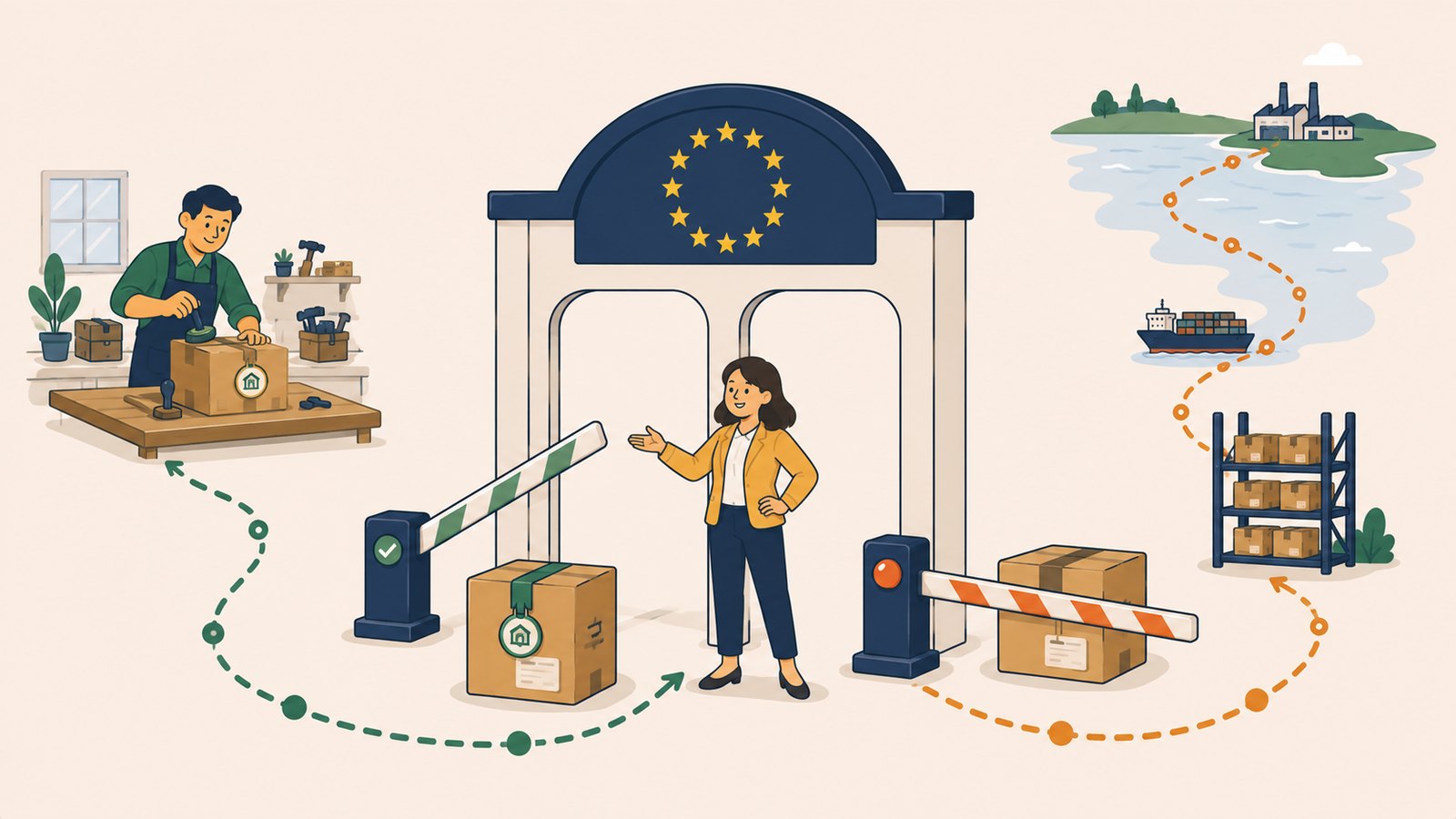
Under the TCA, goods that meet preferential rules of origin can still enter the EU at 0% duty. No €3 flat rate. No percentage tariff. Zero. The catch is that "shipped from the UK" and "UK origin" are not the same thing, and getting this wrong could cost you or land you with a customs penalty.
What preferential origin actually means
Preferential origin under the TCA isn't about where the goods are sitting when you post them. It's about where they were made or substantially transformed.
There are three ways a product can qualify:
Wholly obtained in the UK. The product was entirely produced here using UK materials. Agricultural products grown in the UK, fish caught in UK waters, goods manufactured entirely from UK-sourced inputs. This is the cleanest route but applies to fewer products than you'd think.
Sufficiently processed in the UK. The product uses some imported materials, but enough work was done in the UK to meet the TCA's product-specific rules. These rules vary by product category and are set out in Annex ORIG-2 of the TCA. For some products, the test is a change in tariff heading. For others, it's a maximum percentage of non-originating materials. For others, it's a specific manufacturing process.
Cumulation. EU-origin materials used in UK manufacturing can count as UK content for the purposes of meeting the origin threshold. This is useful if you source components from the EU and assemble in the UK.
The trap: Chinese goods in a UK warehouse
This is where most UK eCommerce sellers will get caught. If you're buying finished products from China (or anywhere outside the UK and EU), storing them in a UK warehouse, and shipping them to EU customers, those goods almost certainly do not qualify for TCA preferential origin.
Warehousing is not processing. Relabelling is not processing. Repackaging is generally not processing. The TCA has specific "insufficient processing" rules that exclude simple operations like repackaging, sorting, labelling, or combining goods into sets.
So a UK Amazon seller who sources finished clothing from a Chinese manufacturer, imports it into a UK warehouse, and ships individual orders to Germany? From 1 July 2026, those parcels face duty. During the interim phase, that's €3 per item. From ~2028, it's the full tariff rate (around 12% for most clothing).
The same applies to dropshippers and print-on-demand sellers if the actual product originates outside the UK/EU.
How to claim preferential origin
If your goods do genuinely qualify, you need to do the paperwork. A TCA origin claim requires a statement on origin made out by the exporter on a commercial document (typically the invoice). The wording is prescribed in Annex ORIG-4 of the TCA.
For UK exporters, the reference number in the statement is your EORI number, whatever the consignment value. The UK doesn't use the EU's REX registration system for exports. REX applies to EU exporters shipping in the other direction, who need a REX number for consignments over €6,000.
The statement must include your EORI number, the origin of the products, and enough product description to identify the goods. It's not complicated paperwork, but it needs to be accurate and you need to be able to back it up.
Supplier declarations: proving your inputs
If your product uses inputs from multiple sources, you need evidence that the origin rules are met. This comes from supplier declarations, where your suppliers confirm the origin of the materials or components they provide to you.
There are two types: a single-shipment declaration for a specific delivery, and a long-term declaration covering a period of up to two years for regular supplies of the same goods.
Get these in place before you need them. If customs authorities query your origin claim, you'll need to produce supporting evidence. "My supplier told me it was UK-made" isn't enough without the declaration on file.
What happens if you claim origin incorrectly
Claiming preferential origin you're not entitled to is a customs offence. The consequences range from back-payment of the duty that should have been charged, to financial penalties, to loss of trusted-trader status. EU customs authorities can (and do) verify origin claims, and under the TCA verification procedure, HMRC and EU customs can cooperate to check whether goods genuinely meet the rules.
Don't guess. If you're not sure whether your product qualifies, get a classification and origin assessment from a customs broker or trade adviser before you start making claims.
Practical steps for UK sellers
Audit your product range. Go through your catalogue and categorise each product: wholly UK-made, partly UK-made with imported inputs, or entirely sourced from outside the UK. Only the first two categories have a shot at preferential origin.
Check the product-specific rules. Look up your products' HS codes in Annex ORIG-2 of the TCA. The rules are different for every product category. A textile product has different origin criteria from an electronic component.
Get supplier declarations. For any product where you're claiming UK processing of imported inputs, get written declarations from your suppliers confirming the origin of their materials.
Make sure you have an EORI number. You almost certainly already have one if you're exporting, but it goes in every statement on origin, so check it's correct on your invoice template.
Include the statement on origin on your invoices. Use the prescribed wording from Annex ORIG-4. Make it part of your standard invoice template for EU orders.
Keep records. You're required to keep origin documentation for at least four years. File the supplier declarations, the invoices with origin statements, and any supporting manufacturing or sourcing records.
Which Tools Can Do This?
HMRC's Trade Tariff tool lets you look up HS codes and check the product-specific origin rules, and GOV.UK's guide to proving originating status walks through how to make a valid claim. The TCA itself (Annex ORIG-2) is publicly available on EUR-Lex and GOV.UK. For complex cases, customs brokers like Customs Support, Landmark Global, or Bespoke Customs can provide origin assessments and help set up your origin documentation.
If you want help assessing your product range, setting up origin documentation, and making sure your EU customs paperwork is right, Fulcrum Three can run that as part of an operations audit.
We'll assess your product range, set up your origin documentation, and make sure your EU customs paperwork is right so you can keep shipping duty-free where you qualify.
Book a Free Operations Audit →