In This Article
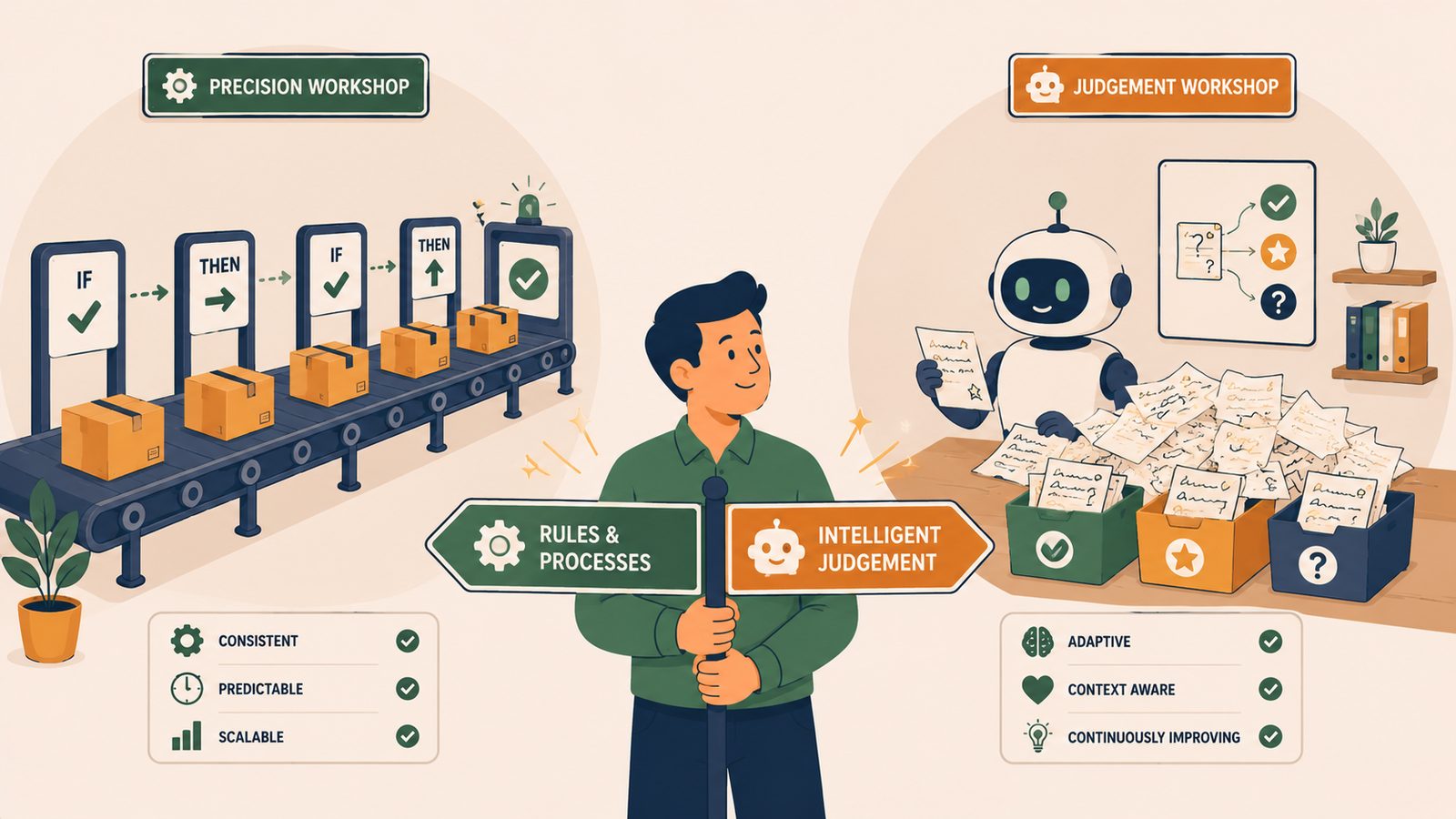
The word automation now covers two very different things. Traditional automation follows rules you write: if this happens, do that. AI automation makes judgement calls on inputs nobody scripted for. Both get sold under the same label, usually with an AI badge slapped on the pricing page, and business owners are left guessing which one they actually need.
That guess has real consequences. Put rules where you needed judgement and the automation breaks the first time reality doesn't match the script. Put AI where a simple rule would do and you pay more, wait longer, and get answers you can't fully trust.
The good news is that deciding between them is not complicated. This post walks through the difference, where each earns its keep, and a simple test you can apply to any task on your list.
What Traditional Automation Actually Is
Traditional automation is deterministic. You define a trigger, a condition and an action, and the system executes exactly that, every time, until you change the rule. When an invoice arrives, match the PO number and mark it reconciled. When stock on a SKU drops below its threshold, send a restock alert. When an expense claim comes in over £500, route it to a director; under £500, approve it automatically.
There is no interpretation happening in any of that. The system is not deciding anything. It's following instructions, quickly and without ever getting bored, at a volume no person could sustain. Given the same input, you get the same output, every single time. You can test it, audit it, and explain to your accountant exactly why the system did what it did on any given Tuesday.
For predictable, repeatable, high-volume work, this is still the right tool, and nothing about the last few years of AI progress has changed that. For the broader picture of what this covers across a business, see our guide to what business process automation is.
The limitation is equally clear. Rules only work when you can write the rule. The moment the input stops being predictable, an email that could mean three different things, a document that doesn't follow the template, rules-based automation either fails outright or, worse, does the wrong thing confidently.
Where AI Automation Is Different
AI automation handles the inputs you can't write rules for. Instead of matching exact conditions, it interprets. It reads a rambling customer email and works out that underneath three paragraphs of backstory, this is a refund request for a damaged item. It takes a scanned supplier PDF in a layout you've never seen and still pulls out the invoice number, the total and the VAT breakdown. It reads meaning rather than matching patterns.
That opens up a category of work automation simply couldn't touch before. Reading unstructured emails and routing them by intent. Classifying documents that don't follow a template. Drafting replies or report summaries for a person to review. Condensing a fifty-message complaint thread into five bullet points. All of it used to need a person, because the input was too messy for rules.
Notice the shape of those tasks. They all involve judgement about meaning, and they all produce output a human can quickly check. That second part matters more than most people realise, and we'll come back to it. If you want a deeper look at how these systems work in practice, our guide to AI agents for small business covers it properly.
Why "AI Everything" Is Usually the Wrong Answer
Given how capable AI has become, the tempting conclusion is to run everything through it. This is usually a mistake, for three unglamorous reasons.
Cost is the first. A rules-based workflow costs effectively nothing per run once it's built. Every AI call costs money, and those fractions of a penny compound quickly across thousands of runs a month. Paying an AI model to check whether a number is bigger than a threshold is paying for judgement where no judgement exists.
Unpredictability is the second, and it bites hardest. Rules give you the same answer every time. AI gives you a very good answer most of the time, and occasionally a wrong one delivered with complete confidence. For drafting an email a human reviews, that's fine. For calculating VAT or deciding who gets paid, it isn't.
Auditability is the third. When a rules-based system routes an approval, you can point at the rule that fired and show exactly why. When an AI model makes a call, the reasoning is much harder to reconstruct. If a process feeds your accounts or might one day need explaining to HMRC, that difference is not academic.
None of this is an argument against AI automation. It's an argument against using an expensive, probabilistic tool for jobs a cheap, deterministic one does better.
The Best Systems Use Both
In practice, the strongest automations we see are hybrids, and they follow a consistent pattern: rules form the skeleton, AI handles the messy edges, and humans keep the final call on anything that matters.
Take supplier invoices. Rules watch the inbox, file each attachment and log it. AI reads the invoice, whatever format it arrives in, and extracts the details into structured data. Rules take over from there: match against the purchase order, and if everything lines up within tolerance, mark it for payment. Anything that doesn't match goes to a person with the discrepancy already highlighted. AI did the one step rules couldn't do, reading a messy document, and nothing more.
Customer emails follow the same shape. AI classifies each message by intent and urgency, because customers don't write to a template. Rules then route each category to the right place and trigger the right follow-ups. Anything sensitive gets a drafted reply that a human approves before it goes anywhere near a customer.
The pattern holds almost everywhere. Deterministic steps stay deterministic, the interpretive gap goes to AI, and judgement calls with real consequences stay with people.
A Simple Test for Any Task
When you're staring at a task and wondering which approach fits, three questions get you most of the way there.
Is the input structured? If the task starts from tidy, predictable data, a number in a field, a status change, a date, rules will handle it. If it starts from free text, inconsistent documents, or anything a person currently has to read and interpret, that's AI territory.
Is the output checkable? A drafted email or a suggested category can be glanced at and corrected in seconds, which makes occasional AI mistakes cheap. If nobody will review the output before it takes effect, you need either the certainty of rules or a human checkpoint built in.
What does a wrong answer cost? A mislabelled support ticket gets fixed in a minute. A wrong payment or a bad message to your biggest customer does not. The higher the cost of an error, the more the task should lean on deterministic rules and human sign-off, whatever the input looks like.
Structured input, unchecked output, expensive mistakes: rules. Messy input, reviewable output, cheap mistakes: AI. Most real tasks land somewhere in between, which is exactly why most good systems combine the two.
Where to Start
Don't start with the technology. List the ten tasks that eat the most time in your business, then run each through the three questions above. Most will turn out to be plain rules-based work that could have been automated years ago, with two or three genuine AI candidates among them.
Build the boring rules first. They're cheaper, faster to deploy and easier to trust, and they'll teach you how automation behaves in your business before you add the probabilistic layer on top.
Which Tools Can Do This?
Power Automate (part of Microsoft 365) handles both rules-based flows and AI steps through Microsoft's AI Builder. Make and Zapier are strong no-code options that connect to AI models such as OpenAI, Claude and Gemini for the classification, extraction and drafting steps, while keeping the surrounding logic as ordinary rules. For more complex hybrid workflows, custom API solutions stitch the two together properly.
If you'd rather have someone work out which of your processes need rules, which need AI and which need both, that's what Fulcrum Three does.
See which of your processes need rules, AI or both.
Book a Free Operations Audit →